To Grade or Not to Grade, That is the Question
Posted on 22/02/2019
By Sebastian Wieschowski Numismatic Writer
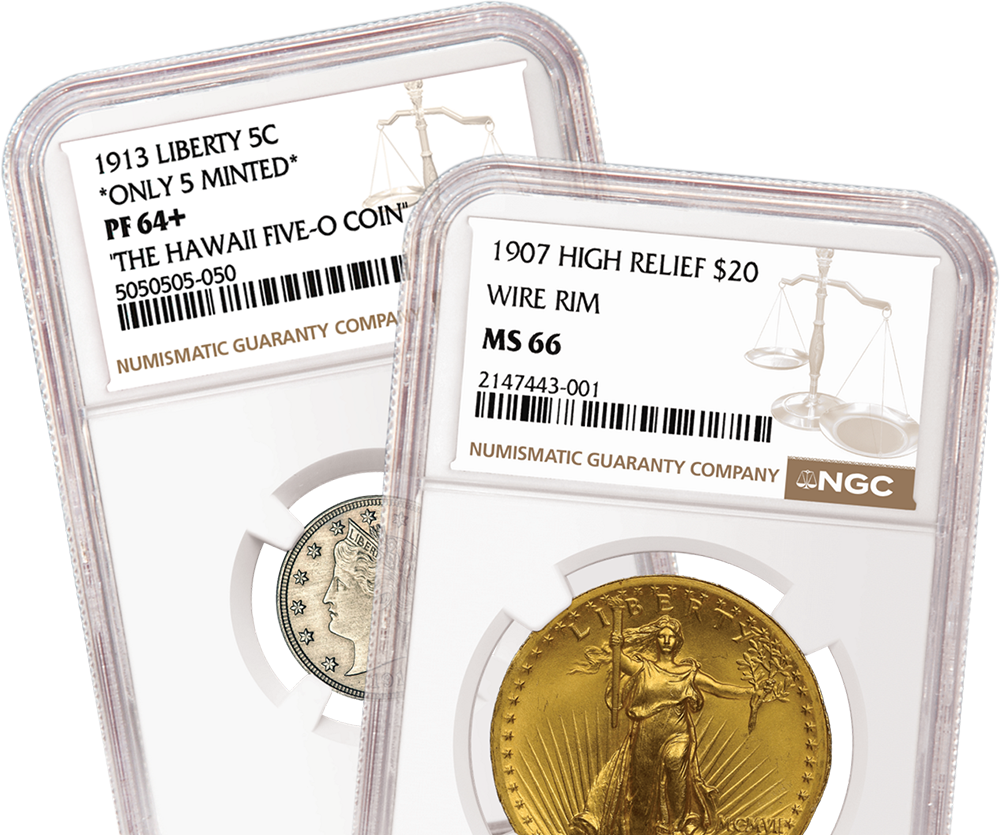
Some talk about third-party grading as the future of numismatics, while others rant about coins in "plastic," which are diminished to an unknown degree. There is hardly any innovation that is so passionately debated in German-speaking numismatics as third-party grading, which is the technical term for the certification of coins by professional and independent providers.
In the past few decades, grading has become the standard in the Asian and US markets, and in Germany, the services of Numismatic Guaranty Corporation (NGC) are on the verge of a breakthrough. But in some corners of the numismatic world, the hard plastic holders and the numerical assessment based on the Sheldon scale have not been embraced.
At the World Money Fair, which took place from 1 to 3 February 2019 in Berlin, proponents and critics of third-party grading came together to share their views. The coin show organizers wanted to reinvent the globally renowned event of the numismatic industry with discussions and workshops for collectors, investors and dealers, In this vein, a panel discussion was set up in cooperation with NGC. And as the five panelists made clear in the beginning, the front line is located exactly at the linguistic border between the German and English-speaking markets.
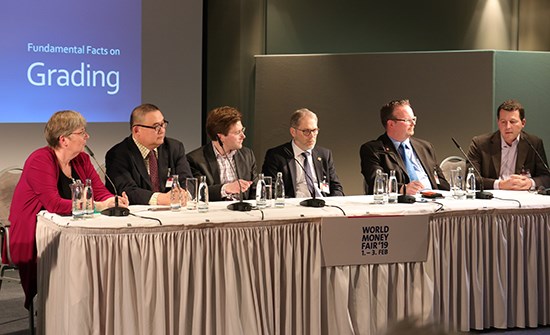 |
| Panelists take part in a discussion about third-party grading at the World Money Fair in Berlin in February 2019. |
Michael Chou (owner of the auction house "Champion Auction") and Sam Spiegel (Director of International Numismatics at Heritage Auctions) spoke out in favor of third-party grading. Arne Kirsch (President of the international coin dealer association IAPN - AINP), Christoph Raab (Managing Director of the well-established German coin dealership Dr. Busso Peus Nachf.) and Marius Haldimann (head of “Swissmint") voiced the opposite view.
In the ensuing discussion, the audience was provided with a concise overview of potential benefits and criticisms surrounding third-party grading: Mr. Chou, who is an expert in the Asian market, made it clear that there was an urgent need for an independent opinion in Asia: "There are so many forgeries that made many collectors turn their back on numismatics sooner than later." Chou explained that a "raw" coin in the Asian market is virtually unsalable because the potential buyer would immediately ask what's wrong with the coin if it has no grade. "I bought a raw coin for $500,000 in Germany a few years ago; that would not happen anymore," Chou said.
The panelists agreed on the need to protect against counterfeiting in the Asian market. However, it became clear how emotionally charged the topic of third party grading is in Germany. For example, Mr. Raab made clear: "If I cannot touch the coin, I cannot develop a passion." To him, a coin in the holder is downright "dead" and being viewed just as an anonymous “object” with a number. "There's just some random piece of metal in there that is supposed to have a value. I cannot develop any enthusiasm for that," Mr. Raab said.
Mr. Spiegel, head of the international numismatics section at Heritage Auctions, emphasized the importance of authentication in the grading process. He also pointed out another advantage of third party grading: The unbiased opinion about a coin helps both the sellers and the buyers because it provides transparency. For example, a Details grade makes a deficiency in the coin unmistakably clear, whereas in the German system of only three general levels of evaluation, it can be overlooked and not accurately documented. According to Mr. Spiegel, grading gives collectors greater security and discourages collectors from withdrawing from the market.
Nevertheless, the German dealers passionately promoted the commitment of their industry. For instance, Mr. Kirsch called the guarantee of the AINP members, which are fully liable "as long as they live," as being "better than anything else in the coin business." He and his German colleague, Mr. Raab, took the position that there was no need for the services of companies such as NGC on the German market, as the members of the dealer associations already gave extensive guarantees.
However, it became clear in the discussion that – depending on the affiliation to one of the various associations – there would certainly be different rules, creating extra confusion among collectors. In addition, there was an objection from Mr. Spiegel, who pointed out that the guarantees of grading service providers such as NGC are not tied to the lifetime of a dealer. He emphasized that grading services would significantly lower the hurdle for new collectors: "More collectors enter the market, we all make more money, and we're all happy at the end of the day."
An opinion from the AINP or a sworn expert in Germany is very expensive for ordinary collectors, while the grading fees for providers such as NGC are significantly lower.
In addition to the authenticity check, Mr. Spiegel and Mr. Chou highlighted another advantage of third party grading. As Chou explained, dealers are usually well versed in the authenticity of the pieces offered, but grading companies are experts when it comes to examining the condition of a coin. "The graders see tens of thousands of coins a year," Chou said, pointing out that in Asia, most auction participants would not accept auction houses certifying their own coins.
"Our customers want an independent opinion because there is always a suspicion that auction houses may tend to exaggerate the condition of their material," noted Mr. Chou.
Here, Mr. Kirsch energetically disagreed – from his point of view, German auction houses would always describe the pieces accurately. He acknowledged that it was indeed possible to develop an internationally accepted standard for 19th and 20th century coins, but when it comes to coins from the Middle Ages or ancient times, the dealer's experience plays a central role in the dealing process.
Mr. Raab added that he could not apply his craft and expertise in counterfeit detection to coins in hard plastic holders - for example, the examination of the edge, the sound, the weight.
Mr. Spiegel pointed out that the guarantee by German dealers would actually not be necessary, because the authenticity is ensured by reputable grading service providers. This means grading could be considered as a benefit for dealers, who would be freed from the problem of liability in the rare case that a counterfeit coin was not recognized.
While the panelists could not reach a consensus, the German and Swiss representatives expressed their respect for certain aspects of grading. The proponents made clear that they take the skepticism of their colleagues seriously. There was agreement that more background knowledge about the process and benefits of grading would be necessary as well as an ongoing exchange of opinions. The discussion also made clear that both sides share a common passion: the passion for extraordinary numismatic rarities.
Sebastian Wieschowski has worked as an author with a focus on numismatics and precious metals since 2007. His articles have been published in magazines such as MuenzenRevue, MoneyTrend, Coin World and the Journal of East Asian Numismatics. He is the author of the Bullion Book and the Fake Coin Bible and a graduate of the School of Economic and Political Journalism in Cologne, Germany.
This is a guest article. The thoughts and opinions in the piece are those of their author and are not necessarily the thoughts of the Certified Collectibles Group.
Stay Informed
Want news like this delivered to your inbox once a month? Subscribe to the free NGC eNewsletter today!